







Buying guide
Twin Eagles 30-inch Warming Drawer
Hold the side dish. Finish the grill. Sit down to the whole meal.

The decision
Let the last dish catch up.
The Twin Eagles 30-inch Warming Drawer is for the gap between finishing a dish and serving the meal. When the vegetables are cooked but the last steaks are still on the grill, it gives prepared hot food a place to wait at serving temperature. Its useful feature is the combination of heat and moisture control, rather than another way to cook the main course.
We would consider it for an outdoor kitchen that regularly hosts several dishes or finishes food in batches. If dinner usually comes straight from the grill to two plates, a dedicated drawer may add less than the counter or storage space you would give up.
The problem it can solve
One dish finishes before another. The drawer can hold already-hot food while you finish the meal, with the vent set around whether that dish should retain moisture or release it.
The problem to solve elsewhere
Cold leftovers need proper reheating, and raw food needs cooking. Do not treat a low warming setting as a shortcut for either job. This appliance’s main role is holding prepared hot food.
Heat and moisture
The vent matters as much as the dial.
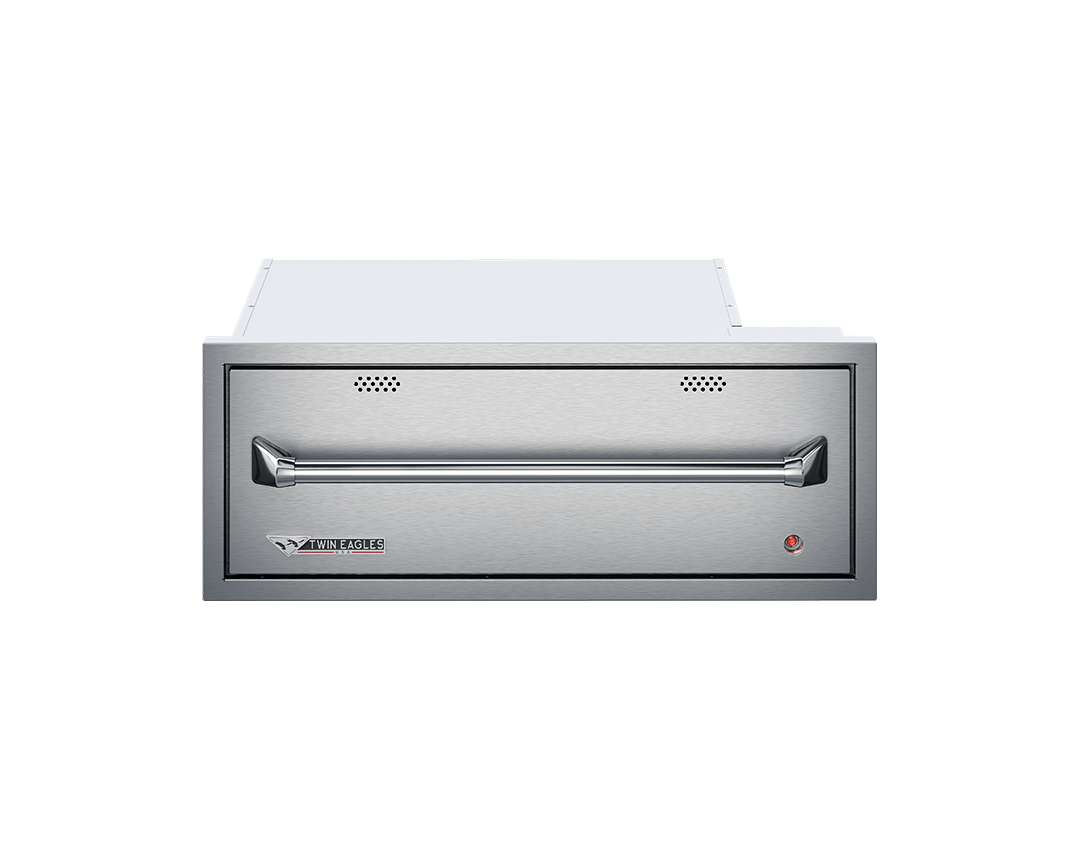
The temperature dial has settings from one to ten, covering approximately 60°F to 220°F. A separate moisture vent lets humid air escape or keeps more moisture inside. Opening the vent helps with foods you want to keep crisp; closing it suits moist holding. Neither control restores a crust that has already softened, and the drawer is not a promise that every dish can wait indefinitely.
Dry holding: release moisture
For a crisp food, the manual uses empty steam pans without added water and an open vent. Start with the texture you want at the table; trapping steam is a different choice from letting it escape.
Moist holding: retain moisture
For moist heat, the manual calls for about half an inch of water in the steam pans, with racks and suitable containers as directed, and the vent closed. Check the water level during use.
The vent controls the drawer’s shared environment. It does not create separate dry and moist compartments for dishes with opposing needs. If one dish needs crisp holding and another needs steam, plan which one belongs in the drawer and which should finish closer to serving.
A serving plan
Work backward from the moment you sit down.
| Situation | Useful approach | What to check |
|---|---|---|
| A hot side finishes early | Hold it hot while the last dish finishes. | Choose the moisture setting for its texture and verify the food temperature. |
| Several batches need serving together | Use the drawer as a holding stage, then serve promptly. | Plan container fit and keep openings brief. |
| Cold leftovers need warming through | Reheat properly with a suitable cooking appliance first. | A warming dial is not proof of safe internal food temperature. |
| You want to proof yeast dough | Use the manual’s lowest-setting dough procedure. | This is a separate use from holding cooked food hot. |
For a mixed grill dinner, choose which prepared side can wait and which food should come straight off the grill. A crisp potato side and a moist rice dish ask for different conditions; decide which one will use the drawer before both are finished. Put the hot holding dish in, close the drawer between adding and removing food, and finish the last cooking task.
Use a food thermometer, not the number on the dial, to check hot holding. USDA advises keeping hot food at or above 140°F. The drawer’s lower settings serve other uses; the full 60°F–220°F control range is not a safe hot-holding range. Read USDA’s hot-food holding and reheating guidance.
The Hearth Outpost view
Buy it for the bottleneck you actually have.
We like a warming drawer when the cook is ready to sit down but dinner is still arriving in installments. Holding a prepared side gives you another way to manage that last stretch, especially when you cook in batches for guests. The moisture vent is the detail to understand: warm and crisp is a different job from warm and moist.
We would not add it just to fill an opening under the grill. Think through a meal you regularly host. If you can name the dish that always finishes too soon, the drawer has a clear role. If you cannot, keep that island space available until the need becomes obvious.
Ratings cover the Twin Eagles warming drawer family.
Know the limits
A dough-proofing setting is a different tool.
The manual includes a yeast-dough proofing procedure using the lowest dial setting, with the dough in a bowl and covered as directed to limit surface drying. Judge the rise by the dough’s progress, following the instructions, rather than assuming a fixed proofing time.
Keep that low-temperature use separate from holding cooked food hot. For leftovers, reheat to the appropriate internal temperature first; USDA’s guidance specifies 165°F for reheating. The warming drawer then has a holding role. Do not rely on a slow warming cycle to bring refrigerated food through the temperature danger zone.
Use heat-suitable containers. The manual prohibits plastic containers, utensils and plastic wrap for heating in the drawer; it also says not to line the drawer with aluminum foil, which can trap heat beneath it. The red heat-on light cycles with the heating element. It indicates operation, not the temperature inside a particular dish.
Fit the island
Thirty inches names the front, not the opening.
The exact 30-inch model requires a 28½-inch-wide × 21¼-inch-deep × 10-inch-high opening according to its specification drawing. The wider 42-inch warming/storage model has a different enclosure arrangement; do not borrow its cutout from the shared manual.
Plan support, the drawer’s full opening path and access for service. The installation instructions call for supporting the casing, securing it correctly and sealing the edges against water entry. Keep it away from sprinklers and protect the island from rain and harsh weather when not in use.
The electrical rating is 120V, 60Hz, 450 watts and four amps, with a power cord and grounded three-prong plug. Use the specified GFI-protected outdoor connection, and have a qualified technician confirm the complete installation. Place the outlet within reach of the supplied cord and keep it accessible. A nearby outlet still needs to be appropriate for the site and appliance.
This guide covers the 30-inch electric drawer. A larger warming-drawer/storage combination is a different product, not a wider version to substitute into the same opening. Bring the dimensions of the dishes you normally serve from. Confirm their fit, the supplied pan arrangement and any additional serving containers with us before ordering.
Shop the drawer
Continue with the exact configuration.
Choose the exact 30-inch drawer, then review the cutout, supporting island and electrical connection together.
Ownership support
Two years on covered parts.
Twin Eagles gives the warming drawer two-year limited coverage against defects in materials and workmanship under normal residential use. The manual also provides a one-year full warranty, with service through an authorized representative. That adds a second year of covered parts after the full-warranty period.
- Limited parts coverage
- 2 years
- Full warranty
- 1 year
- Intended setting
- Home use
The warranty applies to the original owner for products purchased and located in the continental United States and Canada. Register within the required thirty days and keep proof of purchase. Labor, shipping/handling and other owner costs apply under the limited parts term; removal, installation and access costs have their own exclusions. Normal weather staining, minor surface rust and damage from improper installation or maintenance are excluded. Read the complete warming drawer warranty.
Before ordering
Make room for an easier finish.
Let’s plan the last part of dinner.
Tell us what you serve and where the drawer would go. We can help you review the Twin Eagles model, supplied equipment and installation documents around the way you entertain.
Speak to an Expert
Good questions
What the drawer does for dinner.
Does the warming drawer cook raw food?
Its primary function is holding hot cooked food at serving temperature. Use a suitable cooking appliance for raw food and proper reheating before hot holding.
Should I use the lowest setting for cooked food?
No. The lowest setting is used in the manual’s yeast-dough proofing procedure. USDA advises holding hot food at or above 140°F; check the food itself with a thermometer.
Can one dish stay crisp while another uses moist heat?
The moisture vent sets a shared drawer environment. Plan the dishes around that setting rather than expecting independent dry and moist compartments.
Can I use plastic food containers or line the drawer with foil?
No. The manual prohibits plastics for heating and warns against lining the drawer with aluminum foil. Use suitable containers as directed.
Is the opening thirty inches wide?
The 30-inch model’s front is thirty inches wide; the specified opening is 28½ inches wide × 21¼ inches deep × 10 inches high. Use the exact specification drawing and complete installation instructions.